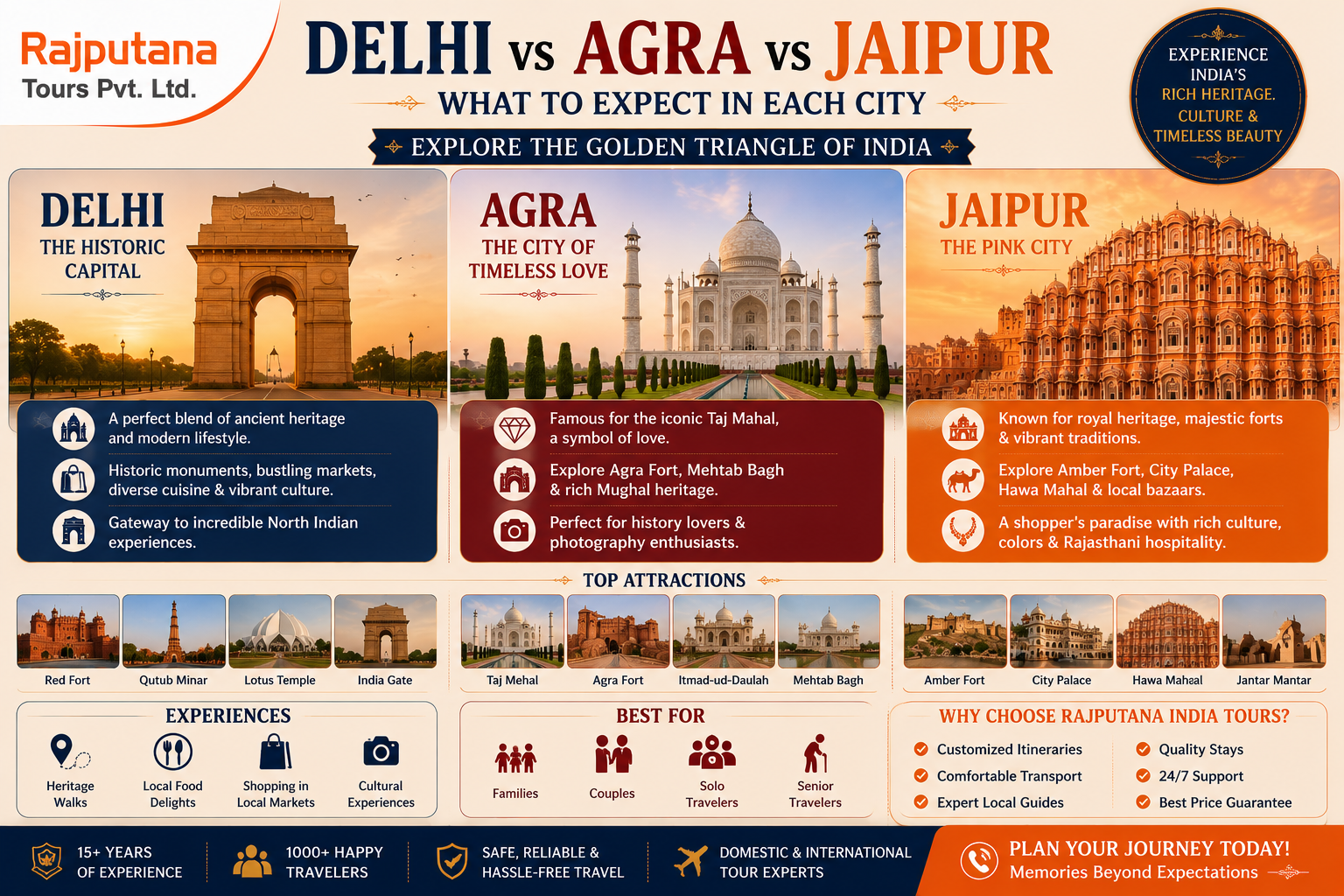
If you’re planning your first trip through India’s Golden Triangle, you’ve probably asked yourself the same question every traveller asks before they land: what actually makes Delhi, Agra, and Jaipur different from each other? On paper they’re just three dots on a map, a few hours apart by road. In reality, each city has its own rhythm, its own smell in the morning air, its own way of making you feel something completely different by the time you leave.
Here’s an honest look at what to expect from each stop, written the way a friend who’s already been there would tell you.
Delhi: Where the Trip Really Begins
Most people land in Delhi tired, jet lagged, and slightly overwhelmed. That’s normal. Delhi doesn’t ease you in gently. Within the first hour of driving from the airport, you’ll see auto rickshaws weaving between government buildings that look like they belong in London, followed a few minutes later by narrow lanes so old they seem to predate the idea of traffic altogether.
That contrast is the whole point of Delhi. Old Delhi, with its Mughal era lanes around Chandni Chowk and the Red Fort, moves at the pace of the 1600s. Cycle rickshaws, spice smells thick enough to taste, and buildings that have watched centuries pass without much interest in modern renovation. Then you drive twenty minutes and you’re in Lutyens’ Delhi, wide colonial avenues, government buildings, roundabouts with more grass than most parks in other cities.
What surprises first time visitors most is how much walking Old Delhi asks of you, and how little walking New Delhi allows for. You’ll want good shoes and patience for the former, and probably a car for the latter.
Give Delhi a day, maybe a day and a half. Long enough to see the Red Fort, Humayun’s Tomb, Qutub Minar and Jama Masjid, but not so long that you lose momentum before Agra. Delhi is best understood as the overture, not the main performance.
Agra: The City That Exists for One Building
Agra is unlike anything else on this trip, and it’s unlike anything else in India, because most of Agra’s identity is built around a single structure. Everything else in the city, the hotels, the marble workshops, the street vendors, exists somewhat in the shadow of the Taj Mahal.
That’s not a criticism. Walking up to the Taj Mahal for the first time, particularly early morning when the light is soft and the crowds haven’t arrived yet, is one of those rare travel moments that genuinely lives up to the hype. Photos don’t prepare you for the scale of it, or for how the white marble seems to shift colour depending on the hour.
But here’s what a lot of itineraries skip: Agra has more depth than tourists give it credit for. Agra Fort, just a few kilometres from the Taj, tells the more complicated, more human side of the same story, the story of an emperor who built the Taj Mahal and later lived out his final years imprisoned within sight of it. Mehtab Bagh across the river gives you a totally different, quieter angle on the monument, especially at sunset. If you have time, the local marble inlay workshops are worth a visit too, since many of the artisans still use techniques passed down from the original Mughal craftsmen.
Most travellers spend one night in Agra. That’s enough for the essentials, but if history genuinely interests you, a second morning at Agra Fort before heading to Jaipur adds a lot without adding much time.
Jaipur: Where the Trip Gets Its Colour
By the time you reach Jaipur, the pace of the trip changes completely. Where Delhi is layered and Agra is singular, Jaipur is expansive. This is the city where the Golden Triangle earns its name in the most literal sense, painted buildings, ochre forts, and a skyline of hills dotted with fortifications that once guarded a kingdom.
Amber Fort is usually the highlight, and it deserves to be. Set on a hilltop outside the city, it’s less a single building and more a small fortified world, courtyards inside courtyards, mirror work that catches candlelight the way it was designed to centuries ago. Go early if you can. By late morning, the courtyards fill up fast.
Inside the city itself, the Pink City earns its nickname honestly. Hawa Mahal’s honeycomb facade is one of the most photographed buildings in India for good reason, though most people don’t realise the building is mainly a facade, designed so royal women could observe street life without being seen themselves. City Palace and Jantar Mantar round out the historical sites, but honestly, some of Jaipur’s best moments happen outside the monuments entirely, in Johari Bazaar bargaining over textiles, or at a Chokhi Dhani evening watching a recreation of traditional Rajasthani village life over a very large thali dinner.
Jaipur rewards travellers who slow down. Where Delhi and Agra can be rushed if your schedule demands it, Jaipur loses something important if you try to compress it into half a day.
So Which City Will You Like Most?
Honestly, that depends entirely on what you’re drawn to. If you love layered history and don’t mind a bit of organised chaos, Delhi will grow on you. If you want one perfect, quiet, almost meditative morning, Agra delivers that in a way few places do. And if colour, craftsmanship, and a sense of living heritage appeal to you, Jaipur will probably end up being the city you talk about most when you get home.
Most travellers on a India Golden Triangle Tour Package end up loving all three for completely different reasons, which is really the whole point of doing the circuit in one trip rather than choosing just one city. Delhi gives you context, Agra gives you awe, and Jaipur gives you colour and warmth to send you home with.
If you’re still figuring out how many days to spend in each city, or want an itinerary built around your own pace, Rajputana Tours can help put together a private trip that gives each city the time it actually deserves.












Post Discussion